Start Here: Home Electrical, Wiring, and Network Guides
Home Circuitry HQ is your plain-language starting point for understanding home electrical systems, safe switch and outlet projects, structured home networking, home theater cabling, EV charging, and smart home energy integration. Every guide prioritizes National Electrical Code (NEC) safety boundaries, CPSC inspection checklists, and clear rules on when a licensed electrician and local permit are required.
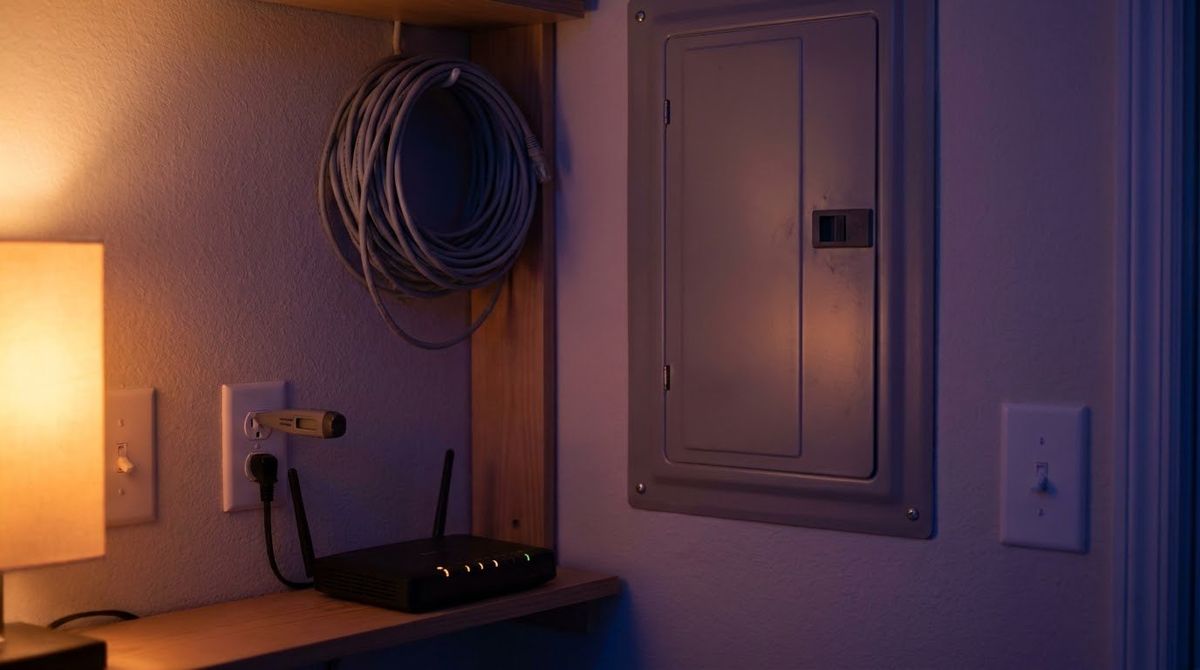
Electrical Safety Disclaimer: Home Circuitry HQ provides general educational information and is not a substitute for a licensed electrician or your local Authority Having Jurisdiction (AHJ). Electrical work can cause fire, electric shock, and death. Always turn power OFF at the circuit breaker, lock or tag the panel, and verify zero voltage with a non-contact voltage tester AND a contact multimeter before touching any wiring. Local building codes adopt the National Electrical Code (NEC) on different schedules (2017, 2020, or 2023) with local amendments—verify local rules before starting any project.
Welcome to Home Circuitry HQ—your plain-language starting point for understanding the electrical wiring behind your walls, the low-voltage cables that power your network and home theater, and the safety boundaries that keep your household protected. Whether you are mapping out your breaker box for the first time, troubleshooting a 3-way hallway switch, or planning a Level 2 EV charger, this home electrical and wiring guide routes you straight to the exact topic hub you need.
Five Non-Negotiable Electrical Safety Rules Before You Start
Every electrical project—no matter how small—begins with verifying that power is completely off and knowing where DIY work stops.
- Shut off the breaker and lock or tag the panel: Never rely on flipping a wall switch to cut power. Turn off the specific branch circuit breaker in your main panel (or the main breaker if the directory is unclear) and place a piece of tape or a tag over it so no one in the house flips it back on while you are working.
- Verify dead with two methods: Test the switch, receptacle, or wire bundle with a non-contact voltage tester (NCVT) first, then confirm zero voltage between hot-to-neutral, hot-to-ground, and across all terminals using a contact multimeter (checking the meter on a known live outlet before and after).
- Follow manufacturer instructions and local code: The NEC requires listed electrical devices to be installed according to their manufacturer’s instructions (NEC 110.3(B)). Check which NEC edition and local amendments your city or county enforces.
- Never mix line voltage and low voltage: Keep 120 V/240 V power conductors strictly separated from Cat6 Ethernet, coax, speaker wire, and HDMI cables inside walls and enclosures.
- Stop and call a licensed electrician immediately if you encounter any of the red-flag conditions listed below.
When You Must Hire a Licensed Electrician (and Pull a Permit)
Do not guess or improvise on high-risk electrical systems. Call a licensed electrician whenever a project involves:
- Electrical panel or service work: Removing the dead-front panel cover, replacing breakers, adding subpanels, or upgrading 100 A/150 A/200 A service.
- Adding new circuits or 240-volt outlets: Running new branch wiring, installing a NEMA 14-50 outlet, or hardwiring a Level 2 EV charger.
- Legacy hazardous wiring: Aluminum branch-circuit wiring (CPSC reports it was used in homes built since the mid-1960s), knob-and-tube wiring, or cloth-insulated wiring with crumbling jackets.
- Active fault symptoms: Warm or discolored wall plates, buzzing switches, burning odors, tingling shocks from appliances, or circuit breakers that trip repeatedly.
How Your Home’s Electrical System Works (Plain-Language Basics)
Understanding the basic anatomy of residential wiring makes every guide on this site easier to follow and helps you communicate clearly with an electrician.
Service Panel, Breakers, and Branch Circuits
Utility power enters your home through the meter and main service disconnect into your main breaker panel. Inside the panel, power divides into individual branch circuits protected by circuit breakers—typically 15-amp or 20-amp single-pole breakers for 120-volt lighting and outlets, and 30-amp to 60-amp double-pole breakers for 240-volt appliances like electric dryers, ranges, heat pumps, and EV chargers.
Hot, Neutral, and Ground Wires
In standard North American 120-volt branch circuits, three conductors work together:
- Hot (ungrounded conductor, typically black or red): Carries 120 volts from the breaker to the switch or outlet.
- Neutral (grounded conductor, white): Completes the circuit by returning current safely back to the panel’s neutral bus. Since the 2011 NEC, a neutral wire is generally required in switch boxes, which many smart switches need.
- Equipment Ground (bare copper or green): Provides a dedicated low-resistance fault path back to the panel so that if a live wire touches a metal box or appliance chassis, the breaker trips instantly instead of energizing the surface.
GFCI vs. AFCI Protection
Modern homes rely on two complementary safety devices:
- GFCI (Ground-Fault Circuit-Interrupter): Monitors current flowing out on the hot wire and returning on the neutral wire. If even a tiny fraction of current leaks to ground (such as through water or a person), the GFCI trips in milliseconds to prevent electrocution.
- AFCI (Arc-Fault Circuit-Interrupter): Detects high-frequency electrical arcing caused by damaged lamp cords, pinched Romex, or loose terminal screws, shutting off power before an electrical fire starts inside the wall.
Essential Homeowner Electrical Testing and Safety Toolkit
Before troubleshooting an outlet or mapping your panel, keep these basic, UL/CAT-rated tools on hand:
- Non-contact voltage tester (NCVT): Quickly checks whether AC voltage is present near a wire or outlet slot before you touch anything.
- Digital multimeter: Confirms exact voltage (120 V vs. 240 V vs. 0 V) by direct contact on terminals.
- Plug-in GFCI receptacle tester: Plugs into standard 120 V outlets to check for correct hot/neutral/ground wiring polarity and tests whether downstream GFCI protection trips properly.
- Insulated screwdrivers and wire strippers: Keep handles clean, dry, and undamaged.
- Label maker or permanent marker: Essential for updating your breaker directory accurately.
Explore Every Topic Hub on Home Circuitry HQ
Use the hub directory below to jump straight to the pillar guide and key supporting articles for your project.
1. Switches, 3-Way Circuits, and Dimmers
Replacing a worn toggle, adding LED dimming, or untangling two switches that control one hallway light starts with understanding terminal roles (Common vs. Traveler) and neutral-wire rules.
- Start with the pillar: 3-Way Switch Wiring Diagram and Step-by-Step Install Guide
- Choose and match LED dimmers: Dimmer Switch Guide: Find Your Perfect Light
- Learn switch types and symbols: Understanding Switches: Types and Uses
2. Outlets, GFCI Protection, and Receptacles
Whether you are upgrading bathroom and kitchen outlets to GFCI, calculating how many receptacles belong on a 20-amp circuit, or planning a 240-volt garage outlet, start with code-compliant outlet placement.
- Start with the pillar: Electrical Safety Upgrades: How to Install GFCI Outlets and Prevent Hazards
- Monthly testing and safety: GFCI Outlet Safety Tips for Your Home
- 20-amp circuit planning: How Many Outlets Can You Put on a 20 Amp Circuit?
- 240-volt EV and RV outlets: NEMA 14-50 Outlet Guide: Install and Safety Tips
- Receptacle reference: Understanding Receptacle Uses and Types
3. Residential Wiring and Breaker Panels
Knowing which breaker feeds every room—and spotting early warning signs of aging wiring—is the single best safety habit any homeowner can build.
- Map your breaker box: Complete Home Electrical Panel Labeling Guide for DIY Homeowners
- Spot aging wiring hazards: Signs Your Home Wiring Needs an Upgrade
4. Home Network and Structured Cabling
Fast, reliable internet depends far more on proper Cat6 cabling, patch panels, and access point placement than on buying an expensive router alone.
- Start with the pillar: Structured Home Wiring: Planning Your Whole-House Network
- Terminate clean Ethernet drops: Ultimate Guide to Patch Panels for Network Success
- Compare wireless technologies: Wi-Fi 6 vs. 5G: What’s Best for Your Home Network?
- Understand fiber cabling: Fiber Optic Cable: Your High-Speed Solution
5. Home Theater, TV Wiring, and Surge Protection
Mounting a flat-screen TV and hiding cords cleanly requires code-approved power kits—never standard power cords stuffed inside drywall—paired with UL 1449 surge protection.
- Start with the pillar: Comprehensive Guide to DIY Home Theater Installation
- Hide TV cables safely: How to Hide TV Wires in Wall Safely
- Organize media gear: 5 Top In-Wall Media Enclosures for Cable Management
- Protect sensitive electronics: Surge Protector Showdown: 7 Models Compared and Safeguard Your Devices with a Reliable Power Strip
6. EV Charging Stations
Charging an electric vehicle at home safely involves matching your vehicle’s onboard charger, your panel capacity, and NEC Article 625 continuous-load sizing.
- Start with the pillar: EV Charging Stations: Find Your Power Solution
- Buying checklist: How to Choose an EV Charger: Complete Home Buying Checklist
- Model comparison: Top EV Chargers for Eco-Friendly Driving
- Public networks and connectors: EV Charging Stations in the US
7. Smart Home Integration and Energy Efficiency
Connecting smart thermostats, neutral-compatible smart switches, PoE cameras, and energy-saving appliances starts with clean wiring and ENERGY STAR certified hardware.
- Start with the pillar: Smart Home Integration 101
- Cut household energy waste: 10 Energy-Efficient Smart Home Gadgets
Understanding Breaker Sizes, Wire Gauges, and Continuous Loads
One of the most dangerous mistakes in home electrical work is assuming a circuit breaker can be swapped for a higher-amperage breaker just because a circuit trips frequently. A circuit breaker’s sole job is to protect the hidden wiring inside your walls from overheating and starting a fire.
- Breaker ratings match conductor size: Standard 15-amp and 20-amp branch circuits are wired with conductors sized for those exact limits. Replacing a 15-amp breaker with a 20-amp or 30-amp breaker allows the wire in the wall to carry more current than it was designed to handle, creating a hidden fire hazard.
- Continuous loads follow the 125% rule: Under National Electrical Code (NEC) Article 625, high-draw equipment that runs for three hours or more—such as Level 2 electric vehicle chargers—is classified as a continuous load. Branch circuits for continuous loads must be sized at 125% of the equipment’s continuous current (often called the 80% rule), meaning a 40-amp continuous EV charger requires a 50-amp dedicated circuit and a 48-amp hardwired charger requires a 60-amp circuit.
- Keep dedicated appliances on dedicated circuits: High-draw heating and motor appliances—such as space heaters, microwaves, sump pumps, and EV chargers—should never share overloaded general-purpose circuits or run through extension cords.
Common Home Electrical Warning Signs You Should Never Ignore
Electrical systems rarely fail without warning. If you notice any of the following symptoms anywhere in your house, stop using the affected circuit, turn the breaker OFF if safe to do so, and call a licensed electrician:
- Warm, hot, or discolored outlets and switches: Faceplates should stay at room temperature. Heat or brown scorch marks indicate a loose wire termination, worn spring contacts inside a receptacle, or an overloaded circuit.
- Burning or “fishy” plastic odor: Overheating wire insulation, backstabbed outlets, or failing breaker bus connections often emit an acrid plastic or fishy smell before visible smoke appears.
- Frequent breaker trips or blown fuses: A breaker that trips once when two space heaters run simultaneously indicates an overload; a breaker that trips immediately upon reset—or trips with nothing plugged in—signals a short circuit or ground fault.
- Lights dimming or flickering across multiple rooms: Brief dimming when a central AC compressor starts can happen, but widespread flickering across different circuits can indicate a loose neutral connection at the main panel or utility service drop, which is an urgent safety hazard.
- Mild tingling or shock from appliances or plumbing: Any shock from a refrigerator, washing machine, or metal faucet points to a dangerous grounding or wiring fault that requires immediate professional inspection.
Legacy Wiring Hazards: Aluminum, Knob-and-Tube, and Two-Prong Outlets
If you live in a home built before 1980, your electrical system may contain legacy wiring methods that require special care and professional evaluation before you swap switches, add smart dimmers, or plug in modern appliances:
- Two-prong ungrounded outlets: Common in homes built before the 1960s, two-prong receptacles lack an equipment grounding conductor. Never snap off the third ground prong on a power cord or use a cheater adapter without grounding the tab; instead, have a licensed electrician evaluate options such as GFCI protection or pulling grounded branch circuits.
- Single-strand aluminum branch wiring: CPSC reports that aluminum branch wiring has been used in homes built since about 1965 and has been linked to overheated terminals at receptacles and switches. CPSC’s guidance is to use only devices marked CO/ALR on the mounting strap and to have a qualified electrician do the work, so never connect a standard copper-only switch or outlet to aluminum wire.
- Knob-and-tube or cloth-insulated wiring: Older insulation becomes brittle with age and breaks apart when disturbed inside a wall box. If you see cloth-wrapped conductors or ceramic knobs in an attic or basement, close the box and schedule a licensed electrical inspection.
How to Vet and Hire a Licensed Electrician
When a project crosses into adding circuits, upgrading panels, installing 240-volt EV outlets, or repairing legacy wiring, hiring the right contractor protects both your safety and your property:
- Verify active licensing and insurance: Ask for the contractor’s state or municipal electrical license number and proof of general liability and workers’ compensation insurance, and confirm both are current.
- Require electrical permits and inspections: A reputable electrician pulls the required local permit with your city or county Authority Having Jurisdiction (AHJ) and schedules the municipal inspection. Unpermitted electrical work can complicate inspections, home sales, and insurance claims.
- Ask about local NEC adoption: Confirm the work will meet the NEC edition your municipality enforces (2017, 2020, or 2023) plus any local amendments for AFCI/GFCI protection.
- Get an itemized written scope: The estimate should specify breaker sizes, receptacle grades (such as industrial-grade NEMA 14-50 outlets for EVs), panel load calculations, and whether drywall patching is included.
Understanding Electrical Permits and Municipal Inspections
Electrical permits exist to protect your family and future homeowners, not just to satisfy paperwork. When your city or county Authority Having Jurisdiction (AHJ) issues a permit for a new circuit, EV charger, or panel upgrade, an independent electrical inspector verifies that wire gauges, breaker ratings, box fill, grounding, and GFCI/AFCI protection match the locally adopted NEC edition.
Unpermitted wiring can create serious problems when you sell your home or file a homeowner’s insurance claim after a fire or water event. While routine maintenance—such as replacing a faceplate, testing GFCI buttons, labeling your panel directory, or running low-voltage Cat6 patch cables—does not typically require a permit, always confirm local rules with your building department before modifying 120-volt or 240-volt building wiring.
Your Six-Month Home Electrical Safety Routine
The U.S. Consumer Product Safety Commission (CPSC) recommends walking through your home every six months—for example, when you change your clocks—to spot hazards early:
- Test every GFCI and AFCI device using the built-in TEST and RESET buttons; have a licensed electrician replace any unit that fails to trip or reset.
- Test smoke and carbon monoxide alarms on every level, inside every bedroom, and outside sleeping areas.
- Check outlets, switches, and cords for warm wall plates, loose plugs, cracked faceplates, or cords pinched under rugs and furniture.
- Verify your breaker panel access: Keep the area in front of your electrical panel clear (OSHA’s workspace rule for equipment up to 150 volts to ground calls for at least 3 feet of depth and 30 inches of width; your local code governs), never store flammables nearby, and confirm your circuit directory is legible.
Want to learn more about how we research, fact-check, and maintain our guides? Visit our About Home Circuitry HQ page.
| Task Category | Typical Voltage / Scope | Who Should Perform It | Permit & Code Note |
|---|---|---|---|
| Testing GFCI outlets, labeling panel, replacing bulbs | User-accessible / no open wiring | Homeowner (CPSC 6-month check) | Replace any GFCI that fails its monthly test |
| Low-voltage Cat6, patch panels, 24 V thermostats | Low-voltage data or thermostat wiring | Homeowner (separate from 120 V) | Maintain NEC separation from line-voltage cables |
| Replacing a like-for-like 120 V switch or outlet | Existing 15 A / 20 A branch circuit | Careful homeowner or electrician | Breaker OFF, verify dead with 2 testers; check local code |
| Adding circuits, 240 V EV/NEMA 14-50, panel work | 120 V / 240 V / service panel | Licensed electrician only | Local electrical permit and inspection required |
Handle low-voltage networking, monthly GFCI testing, and panel directory labeling yourself; hire a licensed electrician whenever adding circuits, opening the breaker panel past the dead-front cover, or working with 240 V loads.
Answers to common questions
What should I do before opening any electrical switch or outlet box?
Always turn the branch circuit breaker OFF at the main panel, lock or tag the panel so no one restores power, and verify zero voltage using both a non-contact voltage tester and a contact multimeter at the device terminals. Never rely on a wall switch being in the off position to assume a wire is dead.
When is a homeowner legally or safely required to hire a licensed electrician?
Hire a licensed electrician and pull local permits for any work inside the electrical panel behind the dead-front cover, adding new 120 V or 240 V circuits, installing NEMA 14-50 or hardwired EV chargers, upgrading service amperage, or working on homes with aluminum wiring, knob-and-tube wiring, or recurring tripped breakers.
What is the difference between GFCI and AFCI protection?
A Ground-Fault Circuit-Interrupter (GFCI) protects people from electric shock by shutting off power in milliseconds when current leaks outside the intended path, such as near water. An Arc-Fault Circuit-Interrupter (AFCI) protects the home from electrical fires by detecting dangerous arcing in damaged cords or loose connections.
How often should I inspect my home's electrical outlets, cords, and GFCIs?
The U.S. Consumer Product Safety Commission (CPSC) recommends completing a room-by-room home electrical safety checklist every six months—such as when changing clocks—and testing GFCI outlets and breakers monthly using their built-in TEST and RESET buttons. Regular checks help catch warm faceplates, damaged cords, and failed GFCIs early.
Can I run Cat6 Ethernet or HDMI cables through the same wall box as 120-volt power wires?
Not in a standard single-compartment box. The National Electrical Code requires separation between low-voltage data/AV cables and line-voltage 120 V/240 V power conductors, with limited exceptions such as listed barriers or divided boxes. Use dedicated low-voltage mounting brackets or listed divided boxes, use only in-wall-rated power kits behind mounted TVs, and confirm details with your local inspector.
Who reviews the electrical guides on Home Circuitry HQ?
Every guide is prepared and reviewed by the Home Circuitry HQ Editorial Team against primary sources including the National Electrical Code (NEC), the U.S. Consumer Product Safety Commission (CPSC), the U.S. Department of Energy (DOE), EPA ENERGY STAR, and manufacturer installation manuals. Our editorial desk does not hold a trade license and never replaces a licensed electrician.
Evidence and sources
- U.S. Consumer Product Safety Commission (CPSC): Home Electrical Safety Checklist (Pub. 513) (cpsc.gov)
- U.S. Department of Energy AFDC: Charging Electric Vehicles at Home (afdc.energy.gov)
- ECM Magazine: Code Quiz on Sizing Overcurrent Protection for EVSE (NEC 625.41, 2023 NEC) (ecmweb.com)
- CPSC: Safety Recommendations for Aluminum Wiring in Homes (cpsc.gov)
- OSHA 29 CFR 1910.303: Electrical General Requirements (working space) (osha.gov)
- EPA ENERGY STAR: Product-Specific Savings (Lighting & Smart Thermostats) (energystar.gov)
- Leviton Support: Do I Need a Neutral Wire for In-Wall Smart Devices? (leviton.com)
- 4-Way Switch Wiring Diagram: Control One Light From Three Places
How a 4-way switch works with two 3-way switches to control one light from three or more places, with a layout, wiring steps, box fill and troubleshooting.
- Structured Home Wiring: How to Plan Your Whole-House Network
Plan a whole-house structured wiring system using ANSI/TIA-570-D cabling grades, star topology, Cat6A drops, and NEC Article 800 separation rules.
- Electrical Safety Upgrades: How to Install GFCI Outlets and Prevent Hazards
Learn where the NEC requires GFCI outlets, how to install and test a GFCI receptacle safely, and when to call a licensed electrician for upgrades.
- Wi-Fi 6 vs. 5G: What Is Best for Your Home Network?
Compare Wi-Fi 6 (802.11ax) and 5G Fixed Wireless Access for home internet: LAN vs WAN roles, 6 GHz Wi-Fi 6E, speeds, latency, and enclosure placement.
- Surge Protector Showdown: 7 Models Compared for Safety and Efficiency
Compare 7 surge protectors from Tripp Lite by Eaton, Furman, Belkin, CyberPower, and Anker using published joules, clamping voltage, and safety specs.
- Comprehensive Guide to DIY Home Theater Installation
Plan and wire a DIY home theater safely—from room layout and Dolby 5.1/7.1 speaker placement to speaker wire gauge, HDMI eARC, and surge protection.