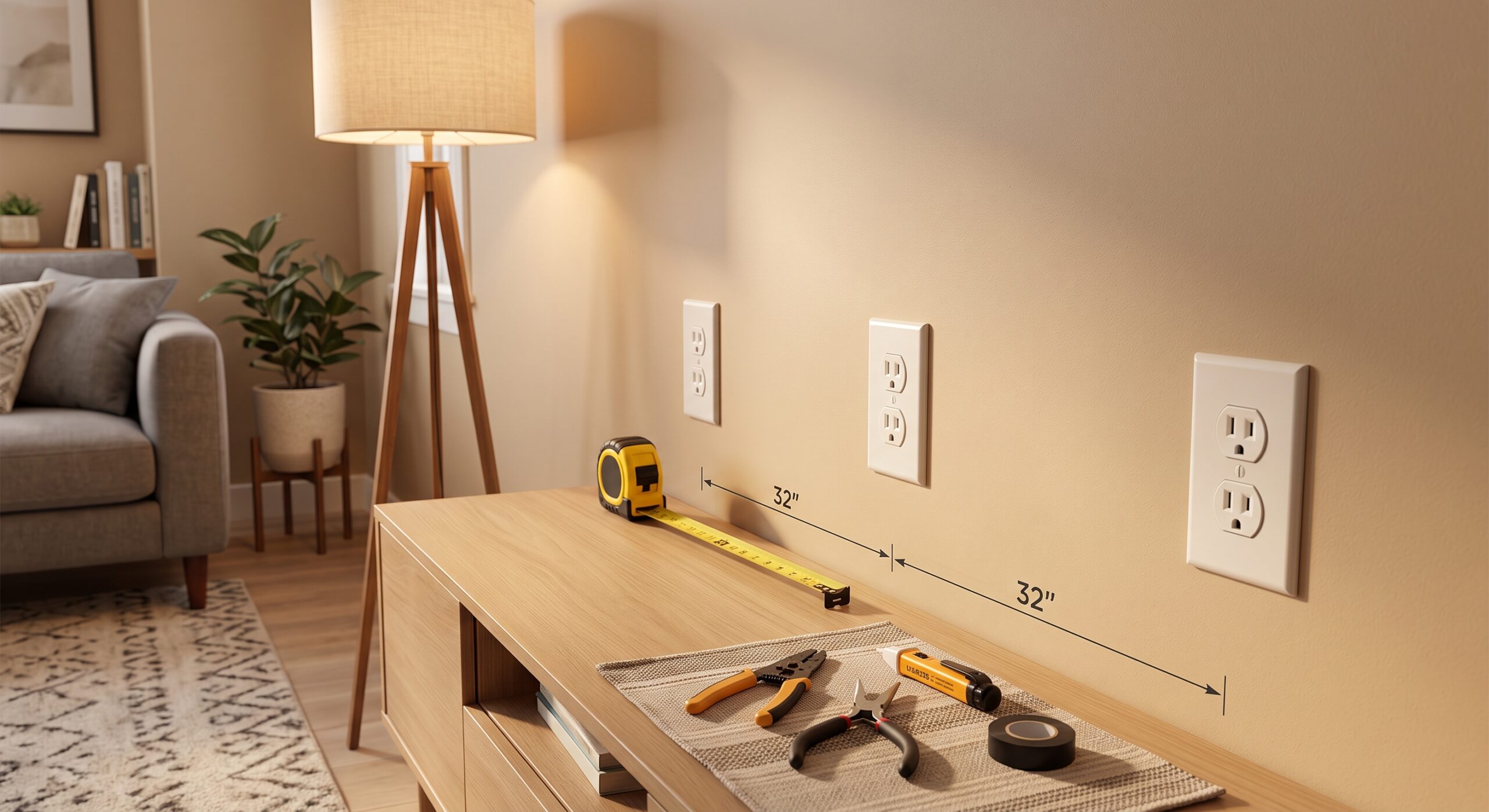
A 20 amp circuit in your home can safely power up to 10 standard outlets, though the exact number depends on how you plan to use them and local electrical codes. A 20 amp circuit handles a continuous load of 16 amps, leaving some wiggle room before the breaker trips. This guide covers outlet spacing, load calculations, and NEC rules for adding outlets to a 20 amp circuit in bedrooms, kitchens, or home offices.
At a Glance
- Maximum outlets on a 20 amp circuit: 10 standard outlets (15A rated) under typical conditions
- Code requirement: NEC 210.11(A)(1) allows 10 outlets per circuit if each is rated 15A or less
- Load calculation: Never exceed 80% of the circuit’s 20A capacity (16A max continuous load)
- Spacing rule: Outlets must be placed every 12 feet along a wall in living spaces per NEC 210.52
- Special cases: Kitchens, bathrooms, and laundry circuits often require dedicated 20A circuits with GFCI protection
Understanding 20 Amp Circuit Capacity: How Many Outlets Fit?
The short answer is 10 outlets on a 20 amp circuit under normal residential use. That’s based on the National Electrical Code (NEC) §210.11(A)(1), which states that a 20A circuit can supply multiple outlets for general use. Each outlet must be rated 15A or less, and the total continuous load cannot exceed 16 amps—80% of the 20A capacity per NEC 210.19(A)(1).
For example, if you plug in two 6-amp appliances like a space heater and a vacuum, you’re already at 12 amps. Add a third device and you risk tripping the breaker. That’s why many electricians recommend planning for no more than 8 outlets per 20A circuit in living areas to leave buffer room for high-draw devices.
The U.S. Energy Information Administration reports that the average U.S. household uses about 30 kilowatt-hours per day. A 20A circuit at 120V supplies up to 2,400 watts continuously. Divide that by typical appliance wattages—a laptop at 60W, a lamp at 60W, a TV at 150W—and it’s clear why spreading outlets across multiple circuits is safer and more practical.
What Counts as an “Outlet” in NEC Terms?
The NEC defines an outlet as a point in the wiring system where current is taken to supply utilization equipment. This includes:
- Duplex receptacles (standard two-outlet wall sockets)
- Single receptacles
- Lighting outlets
- Appliance outlets
So, a single duplex outlet counts as two outlets under NEC rules. A wall box with two sockets could use up two of your 10 allowed outlets on a 20A circuit.
When Can You Exceed 10 Outlets?
You can install more than 10 outlets on a 20A circuit only if:
- The circuit is not supplying continuous loads (for example, lighting circuits in rarely used rooms)
- Each outlet is rated for 15A or less
- You stay within the 80% continuous load limit (16A max)
- Local amendments to the NEC allow it (some jurisdictions permit up to 13 outlets)
For instance, a low-use hallway with six single outlets might be acceptable, but only if you never exceed 16 amps. Always check with your local building department before exceeding 10 outlets.
NEC Code Requirements for Outlets on a 20 Amp Circuit
The NEC (National Electrical Code), Article 210, specifically §210.11 and §210.52, governs how many outlets you can install on a general-purpose circuit. Here’s what you need to know:
NEC 210.11(A)(1): General-Purpose Circuits
This section allows a 20A circuit to supply multiple outlets for general use in dwelling units, like living rooms, bedrooms, hallways, and home offices. The code doesn’t set a hard limit on the number of outlets—but it does cap the load at 80% of the circuit rating.
NEC 210.52: Outlet Spacing Requirements
This is where spacing comes in. For dwelling units, NEC 210.52(A)(1) requires:
- At least one receptacle outlet in every kitchen, family room, dining room, living room, parlor, library, den, bedroom, or similar room
- Outlets must be placed so that no point along a wall is more than 6 feet from a receptacle (or 12 feet apart, measured horizontally along the floor line)
- Hallways longer than 10 feet must have at least one outlet
For example, if your living room wall is 14 feet long, you’ll need at least two outlets—one within 6 feet of each end. This spacing rule often leads homeowners to install 6–8 outlets per room on a single 20A circuit.
What About Kitchens, Bathrooms, and Laundry Rooms?
These areas have stricter rules:
- Kitchens: Require at least two 20A circuits dedicated to countertop outlets per NEC 210.11(C)(1). These must be GFCI-protected.
- Bathrooms: Require at least one 20A circuit for outlets, also GFCI-protected per NEC 210.11(C)(3).
- Laundry rooms: Require a dedicated 20A circuit for the washing machine outlet per NEC 210.11(C)(2).
These dedicated circuits cannot be shared with other rooms. That’s why many DIYers end up with multiple 20A circuits in these high-demand areas.
Calculating Load: How Many Amps Can Your Outlets Handle?
Before you install 10 outlets on a single 20A circuit, run a load calculation. The NEC requires that you never exceed 80% of the circuit’s capacity for continuous loads. Here’s how to do it:
Load Calculation Formula
Total Load (Watts) = Voltage × Current
For a 20A circuit at 120V:
- Maximum continuous load: 120V × 16A = 1,920 watts
- Absolute maximum (non-continuous): 120V × 20A = 2,400 watts
But for safety, stick to the 1,920-watt limit for continuous use.
For example, if you’re wiring a home office with:
- 4 duplex outlets (8 sockets)
- Each socket could supply a device like a laptop (60W), monitor (50W), or desk lamp (60W)
Total estimated load: 8 sockets × 150W average = 1,200 watts
1,200 watts ÷ 120V = 10 amps
This is well within the 16A continuous limit. But if you add a space heater (1,500W) or a laser printer (1,200W), you’re pushing 1,200 + 1,500 + 1,200 = 3,900W, which is 1,480W over the 2,400W max—and your breaker will trip.
What Counts as a “Continuous Load”?
The NEC defines a continuous load as one where the maximum current is expected to continue for 3 hours or more. Examples include:
- Space heaters
- Desktop computers
- Entertainment systems
- Window air conditioners
These devices should not be connected to a circuit that’s already near its limit. Instead, plug them into dedicated circuits or use power strips with built-in circuit protection.
Outlet Spacing Rules: Where Should You Place Them?
NEC 210.52(A) also dictates where outlets must be placed in living spaces. Here’s a quick guide:
| Room Type | Spacing Rule | Recommended Outlets per 20A Circuit |
|---|---|---|
| Living Room | No point >6 ft from an outlet | 6–8 |
| Bedroom | Same as living room | 6–8 |
| Kitchen | One outlet every 4 ft along countertops; no point >24″ above countertop without an outlet | Minimum 4 (but requires 2 dedicated 20A circuits per code) |
| Bathroom | One outlet within 3 ft of sink | 1 (but requires dedicated 20A GFCI circuit) |
| Hallway (>10 ft) | One outlet | 1 |
In hallways longer than 10 feet, you only need one outlet—but if you’re running a single 20A circuit through multiple rooms, you’ll likely install more to meet spacing rules in other areas.
Can You Place Outlets Too Close Together?
Yes—overcrowding outlets on a circuit can cause nuisance tripping, especially if multiple high-draw devices are used at once. The NEC doesn’t limit how close outlets can be, but good practice is to space them every 8–10 feet in living spaces to balance convenience and safety.
For example, in a 16×20 living room, four duplex outlets (8 sockets) spaced evenly would satisfy spacing rules and load limits. Adding more just invites overloading.
Wiring Requirements for a 20 Amp Circuit
A 20 amp circuit requires specific wiring and components to meet safety standards. Here’s what you need:
Wire Gauge and Type
For a 20A circuit at 120V:
- Minimum wire gauge: 12 AWG copper (per NEC 210.19(A)(1))
- Maximum load: 20A breaker with 12 AWG wire: up to 16A continuous
- Wire type: THHN or NM-B (Romex) for indoor use; UF cable for outdoor or wet locations
Using 14 AWG wire on a 20A circuit is a code violation and a fire hazard. Always match the wire gauge to the breaker rating.
Breaker Type and Panel Compatibility
Your panel must accept 20A single-pole breakers. Most modern panels do, but always check:
- Type: Single-pole, 120V, 20A breaker
- Panel compatibility: Make sure it fits your brand (for example, Square D, Eaton, Siemens)
- Space available: Ensure you have an open slot in the panel
If your panel is full, consider a subpanel or arc fault circuit interrupter (AFCI) breaker for added protection.
Outlet Box and Device Ratings
Each outlet must be rated for 15A or higher. Standard 15A duplex outlets are acceptable on a 20A circuit, but 15A outlets cannot be used on a 15A breaker with 14 AWG wire—that’s a common mistake. Always use 12 AWG wire for 20A circuits.
Also, use GFCI outlets or breakers in kitchens, bathrooms, laundry rooms, and outdoor areas per NEC 210.8.
Special Cases: Kitchens, Bathrooms, and Home Offices
While 10 outlets may work in a living room, kitchens, bathrooms, and dedicated workspaces often need dedicated 20A circuits due to higher power demands and safety requirements.
Kitchen Circuits
NEC 210.11(C)(1) requires:
- Two or more 20A circuits dedicated to countertop outlets
- GFCI protection for all kitchen outlets
- Spacing: Outlets must be placed so that no point along the countertop is more than 24 inches from an outlet
Each circuit can power up to 10 outlets, but most electricians split them: one circuit powers outlets above the counter, the other below. This prevents overloading if you’re running a blender, coffee maker, and toaster at once.
Bathroom Circuits
NEC 210.11(C)(3) mandates:
- One 20A circuit dedicated to bathroom outlets
- GFCI protection required
- Placement: Outlet must be within 3 feet of the sink
Never share this circuit with other rooms. Even a hair dryer can push 12–15 amps, tripping a shared circuit.
Home Office or Workshop
These areas often need dedicated circuits for computers, printers, and power tools. A single 20A circuit can power:
- 6–8 outlets
- A surge protector with built-in circuit breaker
But avoid plugging high-draw devices like 3D printers or laser engravers into this circuit. Use a separate 20A or 30A circuit for those.
The U.S. Department of Energy reports that home offices now account for 7% of total U.S. residential electricity use, up from 3% in 2010. That’s why dedicated circuits are becoming more common.
FAQ: Your Top Questions Answered
Can I put 12 outlets on a 20 amp circuit?
Technically yes—if the outlets are 15A-rated, the wiring is 12 AWG, and the total continuous load stays under 16A. But most electricians and inspectors recommend capping at 10 outlets to avoid nuisance tripping and code violations.
Is it legal to have 15 outlets on a 20 amp circuit?
No. NEC 210.11(A)(1) allows multiple outlets, but the code doesn’t set a hard limit. However, exceeding 10 outlets without load justification risks failing inspection and creating a fire hazard. Always check local amendments.
Why do electricians say 8 outlets per 20 amp circuit?
It’s a rule of thumb based on load safety margins. With 8 outlets, you leave room for high-draw devices and reduce the chance of tripping. It’s not code—just good practice.
Can I use 14 gauge wire on a 20 amp circuit?
No. NEC 240.4(D)(7) prohibits using 14 AWG wire on a 20A circuit. It’s a fire hazard. Always use 12 AWG or larger for 20A circuits.
Do I need a dedicated circuit for my fridge?
No, but it’s recommended. A refrigerator typically draws 6–8 amps. On a shared 20A circuit, it’s safe—but if other devices are used at the same time (like a microwave), you risk tripping. A dedicated 15A or 20A circuit is ideal.
Can I daisy-chain outlets on a 20 amp circuit?
Yes, but avoid daisy-chaining more than 4–5 outlets in a row. Each outlet adds resistance, and long chains can cause voltage drop. For best results, use a star topology from the panel to each outlet.
What happens if I exceed the outlet count on a 20 amp circuit?
You risk:
- Tripping the breaker frequently
- Overheating wires and outlets
- Creating a fire hazard
- Failing inspection
Inspectors look for load calculations and proper spacing. If your circuit is overloaded, they can require a fix or red tag your work.
Step-by-Step: How to Plan Your 20 Amp Circuit for Outlets
Planning is key to a safe and code-compliant installation. Follow these steps:
Step 1: Determine Room Use and Outlet Needs
Ask yourself:
- How many devices will be plugged in regularly?
- Are any devices continuous loads (for example, computers, heaters)?
- Do I need GFCI protection (kitchens, bathrooms)?
For a living room with a TV, lamps, and phone chargers, 6–8 outlets is plenty. For a home office with a desktop, monitor, printer, and desk lamp, plan for 8.
Step 2: Map Outlet Locations
Use painter’s tape to mark outlet locations on walls, following NEC 210.52 spacing rules. Aim for outlets every 8–10 feet in living spaces, and within 6 feet of doorways.
For example, in a 12×15 living room, three duplex outlets (6 sockets) along the long walls should suffice.
Step 3: Choose Wire and Breaker
For a 20A circuit:
- Use 12 AWG copper wire (NM-B or THHN)
- Install a 20A single-pole breaker in your panel
- Use a 20A outlet if GFCI is required (for example, bathroom)
Step 4: Run the Cable
Route the cable from the panel to each outlet box, keeping runs as short as possible. Avoid sharp bends—maintain a bend radius of at least 5 times the cable diameter. Secure with staples every 4.5 feet.
Use an OSHA-compliant cable run through studs or joists. If drilling through framing, keep wires at least 1.25 inches from the edge to prevent nail damage.
Step 5: Install Outlets and Devices
At each box:
- Strip 6–8 inches of wire
- Connect black (hot) to brass screw, white (neutral) to silver, and green (ground) to green screw
- Use back-wiring or side-wiring, but torque screws to specification
- Install GFCI outlets where required
Test each outlet with a voltage tester before closing walls.
Step 6: Connect to the Breaker and Test
Turn off the main breaker, install the 20A breaker, and connect the circuit wires. Turn the main back on, then test each outlet with a multimeter to ensure 120V. Plug in a load and test the GFCI if installed.
Finally, run a load test: plug in devices totaling 15–16 amps and verify the breaker holds. If it trips, reduce the load or split the circuit.
Common Mistakes to Avoid
Even experienced DIYers make these errors. Avoid them to stay safe and code-compliant:
Using 14 AWG Wire on a 20A Circuit
14 AWG wire is rated for 15A. Using it on a 20A circuit is a fire hazard. Always use 12 AWG for 20A circuits.
Overloading the Circuit with High-Draw Devices
A single hair dryer (15A) can trip a shared 20A circuit. Always plug high-draw devices into dedicated circuits.
Ignoring GFCI Requirements
Kitchens, bathrooms, laundry rooms, and outdoor outlets must be GFCI-protected. Use GFCI outlets or breakers.
Not Following Spacing Rules
Failing to place outlets within 6 feet of any wall point can cause inspection failures. Always measure and plan ahead.
Daisy-Chaining Too Many Outlets
Long chains of outlets increase resistance and can cause voltage drop. Keep runs short and direct.
When to Call an Electrician
While many outlet installations are DIY-friendly, call a licensed electrician if:
- Your panel is full or requires a subpanel
- You’re working near the main service panel or meter
- You’re installing a new circuit (vs. extending an existing one)
- Your home is older and may have aluminum wiring
- You’re unsure about load calculations or local code
According to ASE, 68% of electrical fires in homes are caused by faulty wiring or overloaded circuits. When in doubt, get professional help.
Final Tips for Safe and Efficient Outlet Placement
Follow these best practices to get the most out of your 20A circuit:
- Use power strips with circuit protection for high-draw devices to isolate them from general outlets.
- Label your breaker panel clearly so you know which circuit powers which outlets.
- Consider AFCI breakers for added fire protection in bedrooms and living rooms.
- Upgrade to tamper-resistant outlets in homes with kids or pets—these prevent foreign objects from being inserted.
- Test GFCI outlets monthly using the built-in test button.
Remember: the NEC sets the minimum safety standard. Local amendments may be stricter. Always check with your building department before starting work.
For more on outlet safety, read our guide: GFCI Outlet Safety Tips For Your Home.
Learn about wiring basics in our Home Electrical Wiring series.
Key Takeaways
- A 20 amp circuit can safely power up to 10 standard 15A outlets under typical residential use.
- The NEC allows this based on load calculations and spacing rules, but local codes may vary.
- Always perform a load calculation—never exceed 80% of the circuit’s capacity (16A max).
- Spacing rules require outlets within 6 feet of any wall point in living spaces.
- Kitchens, bathrooms, and laundry rooms require dedicated 20A circuits with GFCI protection.
- Use 12 AWG wire for 20A circuits—never 14 AWG.
- Plan for 6–8 outlets per circuit in most rooms to leave buffer room for high-draw devices.
- When in doubt, call a licensed electrician—especially for panel upgrades or new circuits.
Additional Resources
Want to go deeper? Check out these related guides: